Senior Product Designer
Sling Video Player Redesign
A cross-platform player redesign focused on clearer controls, adaptive layouts, and smoother browse-to-play continuity.
Snapshot
Sling’s video player is one of the most important surfaces in the product. The existing experience had grown clunky across platforms, with controls that were difficult to scan, interaction patterns that felt inconsistent, and a viewing flow that did not always respect the difference between live TV and on-demand content.
I supported the player redesign across mobile, web, and TV surfaces, helping define clearer control hierarchy, adaptive layouts, and interaction patterns for different viewing contexts.
Problem
The player needed to do two things at once: stay out of the way of the content, and make critical actions easy to find when users needed them. The previous experience struggled with both. Controls competed for attention, advanced settings were hard to discover, and live TV behaviors were being asked to share too much of the same mental model as on-demand playback.
My Role
I supported interaction models, control hierarchy, motion behavior, responsive layouts, error states, mini-player, binge, recording, more-options, and portrait-playback flows. I partnered with the Player team, product, and engineering to help the system scale across input methods, screen sizes, and platform constraints.
Key Decisions
Separate live and on-demand needs
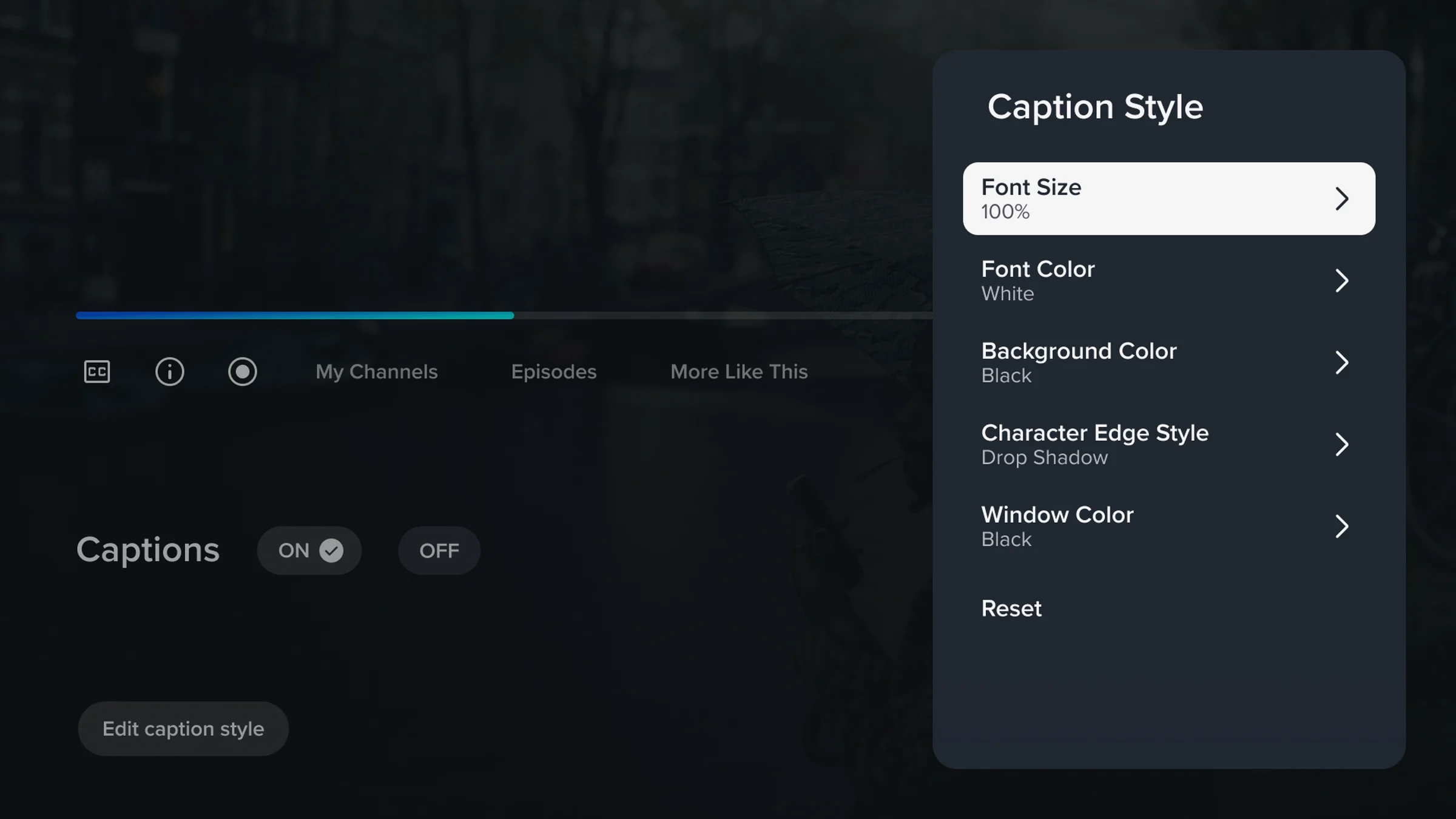
Live TV viewers need fast orientation: what is on now, what is next, and how to move through channels. On-demand viewers need richer metadata, episode navigation, captions, and playback confidence. The redesigned player uses shared foundations while allowing context-specific controls to come forward.
Keep the content primary
The design reduces unnecessary chrome and uses progressive disclosure for secondary actions. The goal was not to make the player feel sparse; it was to make every visible control earn its place.
Treat motion as guidance
Motion patterns were used to explain state changes, reveal controls, and make focus behavior easier to follow, especially on TV and remote-driven interfaces.
Outcome
The redesign was associated with a 33% increase in Total Minutes Watched and a 175% increase in sessions. It also created a stronger foundation for future playback features and contributed player patterns back into Sling’s Dark Matter design system.
Reflection
The most useful lesson from this work was the value of designing for context instead of forcing one perfect player pattern everywhere. A scalable experience does not have to be identical on every surface. It needs to feel coherent, predictable, and native to the way people are actually watching.